Balkan Ghosts by Robert Kaplan
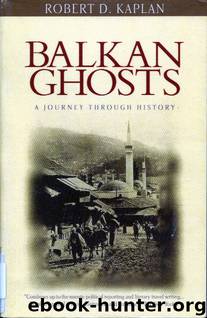
Author:Robert Kaplan [Kaplan, Robert]
Language: eng
Format: epub
Published: 0101-01-01T00:00:00+00:00
[* By 1992, however, a shift in attitudes was finally apparent, as throngs of Romanians greeted Michael in the streets of Bucharest. This positive reconsideration of the ex-king is likely to gain momentum, perhaps leading to his permanent return to the country.]
But Antonescu elicited only praise from Romanians—as a "patriot" who always acted in Romania's best interests and as a "victim" of the Communists, who unfairly convicted him of war crimes when everyone knew that either the Russians or the Germans had murdered the Jews in Transdniestria. The consensus in Romania was that Romanians had had nothing to do with it.
Whatever their views on World War II history, Petru Bejan, Cristian and Alina Mungiu, and the other students at Cuza University in Jassy that I interviewed displayed no current animosity toward Jews. Their anger was now directed against Arabs. I'll have to explain:
The longer Ceausescu remained in power, the more his style of rule began to resemble that of Carol II. Carol, by his own example, encouraged the prostitution franchise. Ceausescu supported comparable activities, but less directly. For political reasons, Ceausescu allowed large numbers of Arab students to attend the universities in Jassy, Bucharest, and Cluj. The Arabs quickly won a reputation for missing classes and for directing their energies elsewhere. The Romanian students I spoke with—as well as Western officials whom I interviewed over the years on this sensitive subject—strongly believed that a significant number of the Arab exchange students were engaged in black-market activities, particularly in running drugs from Turkey and Bulgaria through Romania to the West, with the direct connivance of the Securi-tatae. The drug-running left many young Arabs, not to mention the Securitatae, in possession of sizable amounts of hard currency. In the words of one Romanian professor, the Ceausescu era saw the lobbies of the Traian and Unirea hotels in Jassy, of the Intercontinental in Bucharest, and of the Hotel Napoca in Cluj become "knock shops," where "Romanian prostitutes publicly competed and humiliated themselves for the attention of these Arab boys," whose pockets were full of dollars.
"We hate the Arab students. We know that our civilization— despite the regime—is a European one. But the Arabs come from a lesser civilization and have no respect for ours. They just bought and humiliated us and our women. They buy off professors, too. Everybody at the university knows that the Arabs are the weakest students. In their own countries these students were poor. Here they are rich," Mungiu raged.
Another student told me that the Arabs "are like new feudal lords imposed upon us. When they need a sheep or a goat cooked for one of their religious festivals, they go to a village and pay the peasants to do it. There is nothing wrong with this. But you should see the expressions on their faces. The Arabs act like these peasants are theirs."
I pointed out that Romanians should not judge Arab culture by the students who were sent to Romania, since Arab countries have always sent their best students to the West, and the weakest and least serious ones to Eastern Europe.
Download
This site does not store any files on its server. We only index and link to content provided by other sites. Please contact the content providers to delete copyright contents if any and email us, we'll remove relevant links or contents immediately.
| Africa | Americas |
| Arctic & Antarctica | Asia |
| Australia & Oceania | Europe |
| Middle East | Russia |
| United States | World |
| Ancient Civilizations | Military |
| Historical Study & Educational Resources |
Room 212 by Kate Stewart(5183)
The Crown by Robert Lacey(4862)
Endurance: Shackleton's Incredible Voyage by Alfred Lansing(4845)
The Iron Duke by The Iron Duke(4405)
The Rape of Nanking by Iris Chang(4255)
Joan of Arc by Mary Gordon(4156)
Say Nothing by Patrick Radden Keefe(4043)
Killing England by Bill O'Reilly(4042)
I'll Give You the Sun by Jandy Nelson(3496)
Shadow of Night by Deborah Harkness(3412)
Hitler's Monsters by Eric Kurlander(3385)
Mary, Queen of Scots, and the Murder of Lord Darnley by Alison Weir(3240)
Blood and Sand by Alex Von Tunzelmann(3240)
Eleanor & Park by Rainbow Rowell(3237)
Darkest Hour by Anthony McCarten(3161)
Margaret Thatcher: The Autobiography by Thatcher Margaret(3113)
Book of Life by Deborah Harkness(2984)
Red Famine: Stalin's War on Ukraine by Anne Applebaum(2970)
The One Memory of Flora Banks by Emily Barr(2898)
